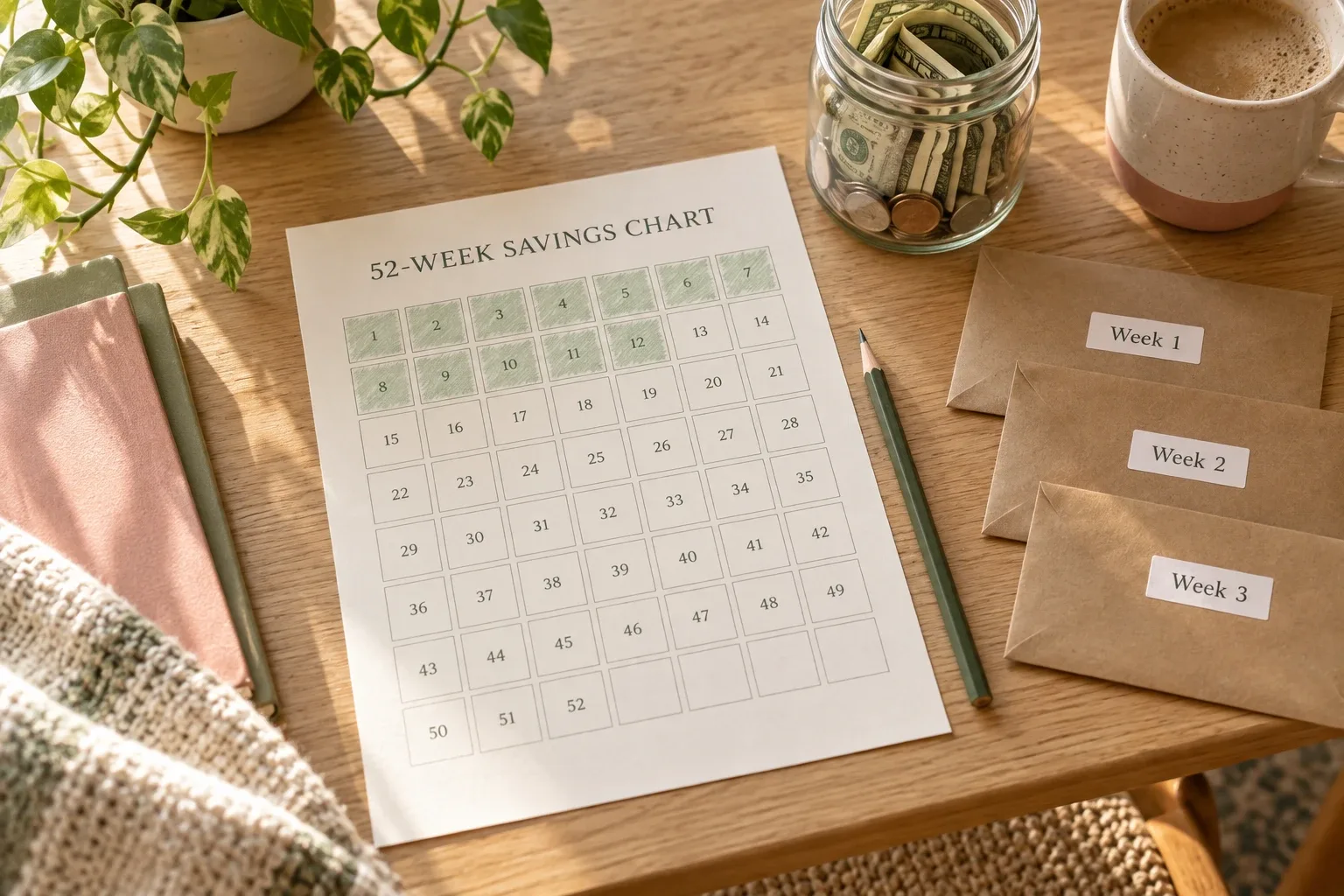
Choose the contribution your hardest normal week can support. A small repeatable amount, a pause rule, and optional extras work better than a target that creates a new shortfall.
A money-saving challenge is supposed to help you feel more secure. But many popular versions begin with a target that assumes there is plenty of money left after every paycheck.
That can make a $5 week feel like failure next to a colorful chart asking for $50, $100, or more.
If your income is low, irregular, or already committed to essential bills, the right challenge is not the one with the biggest total. It is the one you can repeat without missing rent, delaying a utility bill, skipping medicine, or putting groceries on a credit card.
The quick answer: use your hardest-week number
Choose a recent week when your regular income had to cover the most important expenses. After bills, food, transportation, medicine, minimum debt payments, and a small checking-account buffer, ask:
What amount could I have moved to savings without needing to move it back?
That amount is your starting contribution.
It might be $2, $5, $10, or $15. A small amount is not a weak goal. It is a contribution that matches your current capacity.
Use that number for four weeks before increasing it. On easier weeks, you can add an optional extra deposit. On harder weeks, use the planned minimum or pause according to the rule you set in advance.
Why a fixed viral challenge can be a poor fit
Popular challenges often make the math easy to understand, but not necessarily easy to afford.
A 52-week challenge that increases every week becomes most expensive near the end. An envelope challenge may ask you to save large random amounts. A strict no-spend month may ignore necessary purchases or the reality of caring for children, relatives, or pets.
The problem is not a lack of discipline. The schedule may simply be disconnected from your cash flow.
A useful challenge should answer four questions:
- What is the money for?
- What is the smallest contribution I can repeat?
- When will I make the contribution?
- What happens during a difficult week?
If a challenge cannot answer those questions, customize it before you begin.
Step 1: protect essentials before choosing a target
Start with the money that must remain available.
List your take-home income for the pay period, then subtract:
- housing;
- utilities and phone;
- groceries and household basics;
- transportation needed for work or daily life;
- medicine, healthcare, and insurance;
- minimum debt payments;
- childcare or other required family costs;
- bills due before the next payday;
- a small buffer for ordinary variation.
Savings belongs in a budget, but it should not be funded by creating a new shortfall elsewhere. Consumer.gov recommends comparing income with bills and other expenses and treating savings as one planned expense. The Consumer Financial Protection Bureau also notes that even a small amount can provide some financial security, especially when money is tight.
If the result is zero or negative, do not force a weekly transfer. Your first challenge can be a tracking challenge: record spending for two weeks, identify one bill or purchase to review, and save only actual money released by that change.
Step 2: calculate a minimum, a normal amount, and an extra
One rigid number can make a challenge fragile. Use three levels instead.
Minimum contribution
This is the amount you can save during a hard but ordinary week without touching money for essentials. It may be very small.
Normal contribution
This is the amount that fits a typical week after your bills and normal spending are covered.
Optional extra
This is money you save only when it actually appears: overtime, a refund, an item sold, a lower-than-expected bill, or part of an extra paycheck.
Step 3: choose a goal small enough to finish
Saving toward “financial security” is important, but too broad for a short challenge. Give the first round one specific job.
Good starter goals may include:
- a $50 checking-account buffer;
- the next prescription co-pay;
- one utility-bill cushion;
- a small car-repair reserve;
- a school expense due next month;
- the first $100 of an emergency fund.
Choose a goal that would make a real problem easier. A completed $50 challenge often teaches you more than an abandoned $1,000 challenge.
After you finish, decide whether to repeat the same challenge, increase the target, or move the money toward a larger emergency fund.
Step 4: match the schedule to when money arrives
The best savings day is usually connected to income, not to a random date on a calendar.
If you are paid weekly, save a small amount each payday. If you are paid every two weeks, make two contributions a month. If income varies, save after essential bills for that pay period are reserved.
Automatic transfers can make saving consistent, but only when the timing and amount are safe. The CFPB warns that an automatic transfer can cause an overdraft if there is not enough money in checking. If your balance changes sharply, a payday reminder and a manual transfer may be safer than a fixed automatic withdrawal.
You can automate later once the amount has worked for several pay cycles.
Four low-income savings challenge formats
1. The flat small-amount challenge
Save the same minimum every payday.
Example: $5 each week for 12 weeks creates a $60 buffer. The total is modest, but the rule is easy to remember and easy to restart.
Best for: fairly regular income and someone who wants the simplest possible system.
2. The minimum-plus-extra challenge
Save a tiny planned minimum, then add a percentage of genuine extra money.
Example: $3 each payday plus 25% of any overtime pay or marketplace sale.
Best for: uneven income where some weeks have more room than others.
3. The expense-swap challenge
Choose one flexible purchase you want to make less often. Save only when you skip or reduce that purchase.
Example: if you bring lunch instead of buying it, transfer part of the amount you did not spend. Do not count an imaginary saving if the money was used for another necessary expense.
Best for: someone who wants the challenge tied to one visible behavior.
4. The round-down challenge
At the end of the week, look at the balance available after all near-term commitments. Move only the amount above a chosen safe balance.
Example: if your safe checking floor is $120 and the available balance is $127, transfer $7.
Best for: variable income or variable weekly costs.
Build a pause rule before you need it
A pause is not the same as quitting.
Write down the events that allow you to reduce or skip a contribution. Examples include:
- income was lower than expected;
- an essential bill increased;
- necessary groceries or transportation cost more;
- an urgent medical, family, home, or car expense occurred;
- making the transfer would cause an overdraft or new debt.
When a pause happens, do not double the next contribution automatically. Return to the normal amount when the next safe opportunity arrives.
This rule protects the purpose of the challenge. Savings should create a buffer, not manufacture an emergency.
A realistic 8-week example
Imagine Maya is paid weekly and wants to build her first $75 buffer. After reviewing a difficult recent week, she chooses:
- $5 minimum contribution;
- $10 normal contribution;
- half of any money from selling unused items as an optional extra.
| Week | Contribution | Reason |
|---|---|---|
| 1 | $10 | Normal week |
| 2 | $5 | Higher grocery bill |
| 3 | $10 | Normal week |
| 4 | $0 | Urgent prescription; pause rule used |
| 5 | $10 | Returned to normal amount |
| 6 | $20 | $10 normal + $10 from an item sold |
| 7 | $5 | Lower work hours |
| 8 | $15 | Normal amount + safe extra |
| Total | $75 | Goal complete |
The path is uneven, but the goal is complete. Maya did not borrow to keep a streak alive, and she did not treat the paused week as a failure.
Track only the numbers that help
A savings challenge tracker does not need to be complicated. Record:
- the goal;
- the target amount;
- the minimum contribution;
- each deposit date and amount;
- the current total;
- the amount remaining;
- a brief note when you pause or add an extra.
Check the tracker on payday or during a weekly money check-in. Daily checking usually adds pressure without changing the plan.
If you use a visual grid, let each square represent a small flexible unit, such as $1 or $5. Fill several squares during a strong week and none during a pause week. The tracker should adapt to your money, not demand that your money adapt to the graphic.
What to do after a missed contribution
First, check whether the money was needed for something essential. If so, the pause rule worked.
Then choose one of three next steps:
- Resume the normal amount at the next safe payday.
- Lower the minimum for the remaining weeks.
- Extend the finish date without changing the weekly amount.
Avoid taking money back out of the challenge just to preserve the original deadline. A later finish with no new debt is usually a better result than an on-time finish that destabilizes the rest of the budget.
Common mistakes
Copying a challenge total without checking the weekly math
Divide the total by the number of contributions before committing. The weekly or payday amount matters more than the headline total.
Starting from the best month
A challenge built around overtime, a bonus, or an unusually low bill may collapse during a normal month. Use a harder recent period as the baseline.
Increasing the amount too quickly
Test the same contribution for at least four weeks. Increase it only after the money has stayed in savings and your essential bills remained covered.
Saving and then using credit for normal expenses
If the transfer causes you to put groceries or fuel on a card, the target is too high or the timing is wrong.
Treating a pause as failure
The goal is a repeatable saving habit and a useful cash buffer. A perfect streak is optional.
A simple digital tracker option
If you prefer to see the challenge beside your regular money plan, this focused Notion tracker brings income, expenses, customizable categories, and savings goals into one place. For this method, the useful part is the visible goal and progress area.
Keep the challenge rules in a short note, enter only completed contributions, and review the total during your normal weekly check-in. A tracker can organize the plan, but it cannot decide what contribution is safe for your household.
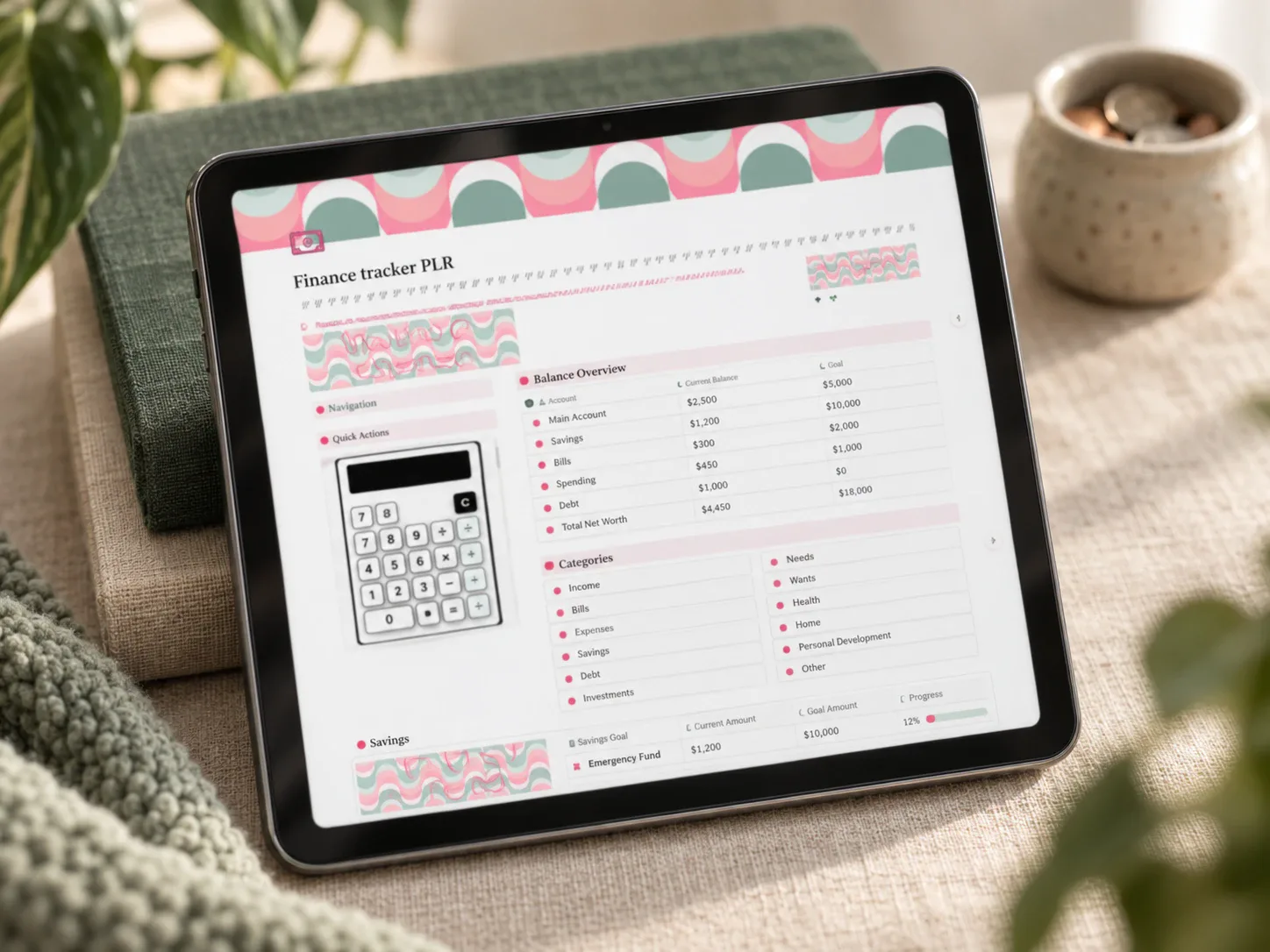 Flexible savings goal
PLR Finance Tracker
A focused Notion tracker for income, expenses, customizable categories, and savings goals. Its visible goal and progress area may suit a challenge with flexible contributions.
Read the tracker guide →Frequently asked questions
How much should I save each week on a low income?
There is no universal amount. Start with what remained during a hard recent week after essentials, required payments, and a small buffer. Test that amount for four weeks before increasing it.
Is saving $5 a week worth it?
Yes, if $5 is genuinely affordable and helps you build a consistent habit. The first purpose may be a small buffer rather than a large final total. You can increase the contribution when your cash flow improves.
What if I cannot save anything this month?
Use a tracking challenge instead. Record spending, review one recurring bill or flexible category, and save only money that is actually freed. Do not create a shortfall to complete a chart.
Should I automate the transfer?
Automation can help when income and balances are predictable. If income varies or your checking balance is tight, use a reminder and confirm the amount manually to reduce overdraft risk.
Should I pay debt or do a savings challenge?
That depends on your obligations, interest costs, available cash, and need for an emergency buffer. Continue required minimum payments. A small buffer may help prevent the next surprise expense from becoming new debt, but personal circumstances differ.
Start with one safe contribution
Look at your last hard week. Protect the money needed before the next payday. Choose the smallest amount you could have saved without taking it back.
Move that amount once. Record it. Repeat it when it is safe.
A challenge that respects your real life may look slower on a tracker, but it has a much better chance of becoming money you can actually keep.
Sources and further reading
- Consumer.gov: Making a Budget
- Consumer Financial Protection Bureau: An essential guide to building an emergency fund
- FDIC: Starting Small Can Lead to Big Savings
Written by Calm Budgets