A vision board answers "what do I want." A plan answers "what do I do this week." Most people only build the first one.
A money vision board is easy to make and easy to look at — a collage of a paid-off balance, a savings number, a picture of the life that number represents. What it does not do on its own is get you closer to any of it. That part needs a plan behind the picture.
This is not an argument against vision boards. It is what to build next to one, so the images point somewhere instead of just being nice to look at.
Why a vision board alone rarely moves the number
A vision board works on motivation and clarity — it tells you what you actually want, which is a real and useful step. It does not break that want into a weekly action, a dollar amount, or a deadline. Without those three things, the board stays a wish rather than a plan.
This is also why vision boards get made in January and quietly stop being looked at by March: the excitement fades faster than an undefined goal can survive on its own.
A vision board answers "what do I want." A plan answers "what do I do this week." You need both, and most people only build the first one.
Pick one image from the board to turn into a real goal
Instead of trying to plan toward everything on the board at once, choose the single image that matters most right now — the paid-off card, the emergency fund, the trip. Give it a specific number and a realistic date.
One goal, worked on for a defined stretch of time, gets more real progress than five vague ones running in parallel.
Break it into a short, defined stretch of time
A full year is hard to stay accountable to — it is long enough that any given week feels optional. A shorter window, like twelve weeks, keeps the goal close enough to feel urgent without the pressure of an entire year riding on it.
Inside that window, break the goal into weekly numbers: how much to save or pay down each week to hit the target by the end date. A vague "save more this year" becomes "$85 this week."
A simple weekly review
- Check this week's number. Did the planned amount actually move, not just get intended.
- Look at the picture again. Thirty seconds with the actual image keeps the "why" attached to the numbers.
- Set next week's number. Adjust up or down based on how this week actually went.
A realistic example
Imagine a vision board built around a $2,400 debt payoff. Instead of a vague year-long intention, the twelve-week version breaks it into $200 a week. By week six, $1,100 is paid off — slightly behind the $1,200 pace, but visibly moving, with six weeks left to close the gap. This is an illustrative example, not a reported personal result.
What usually breaks the picture-to-plan connection
- Trying to plan for every image on the board at once. One goal, worked through fully, beats five left half-started.
- Skipping the weekly number. Without it, the goal has no way to tell you whether this week actually helped.
- Only revisiting the board, never the plan. Motivation without a number attached fades the same way it always has.
Turning the picture into weekly action
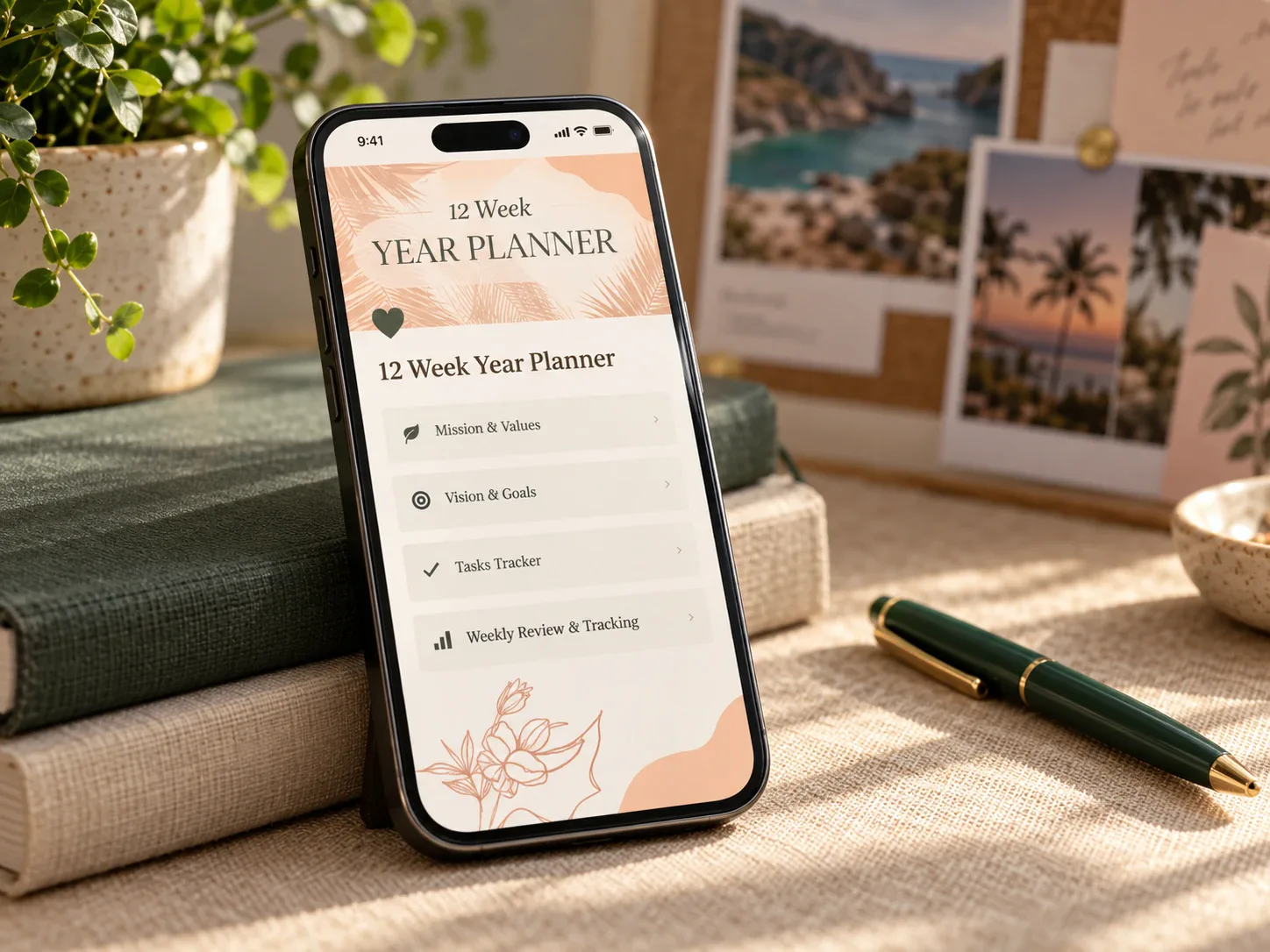 Vision to plan
12 Week Year Planner
A Vision & Goals section paired with weekly review and tracking, tasks, and a daily check-in — built to compress a year-long goal into a focused, trackable twelve weeks.
Read the planner guide →Questions people ask before starting
Do I need to throw away my vision board?
No. Keep it as the reminder of why; add the plan as the answer to how.
What if twelve weeks is not enough for my goal?
Use it for one milestone within the larger goal, then start a new twelve-week stretch for the next one.
What if a week goes badly?
Adjust next week's number rather than abandoning the whole plan. A missed week is data, not a verdict.
Start with one image tonight
Look at your vision board and pick the single image that matters most right now. Write down a number and a date next to it. That pairing — image plus number plus date — is the whole difference between a vision board and a plan.
Written by Calm Budgets