Compare the plan with the actual month, explain one meaningful difference, and make one specific adjustment before copying the budget forward.
A monthly budget should not be a document you copy forward without looking at what actually happened. The end of the month is where the useful information appears: your real income, the bills that changed, the categories you underestimated, and the expenses that were unusual rather than permanent.
That does not mean you need a long financial meeting or a perfect spreadsheet. A focused monthly budget review can take about 20 minutes when the goal is simple:
- compare the plan with the actual month;
- identify the reason behind one meaningful difference;
- make one concrete adjustment before the next month begins.
The review is not a scorecard for whether you were “good” or “bad” with money. It is a short feedback loop. You are using evidence from one month to make the next budget more realistic.
Gather your budget, bank and card transactions, income records, bills, and savings or debt transfers. Confirm actual income, check bills, compare the largest spending categories, review your goals, then choose one change for next month. Do not try to repair every category at once.
What to have in front of you
You do not need a complicated setup, but you do need real numbers. Open or collect:
- the budget you made for the month;
- bank and credit-card transactions;
- pay records or other income records;
- bills and subscription charges;
- savings and debt-payment records;
- notes about cash spending, if you kept them.
If some cash spending is missing, do not invent an exact number. Mark it as unknown and make “track cash for the next 30 days” a possible improvement. An honest incomplete review is more useful than a precise-looking review built on guesses.
Consumer.gov budgeting guidance uses the same basic cycle: plan at the beginning of the month, record what you spend, compare the result with the plan, and use what you learn when planning the next month. Your review turns that cycle into a short routine.
The 20-minute monthly budget review
Set a timer if that helps you avoid getting lost in individual transactions. The purpose is to find the most useful next action, not to create a perfect financial history.
Minutes 0–3: Confirm actual income
Start with the money that actually arrived, not the income you expected. Write down planned take-home income, actual take-home income, the difference between them, and whether the difference is likely to happen again.
This step matters when your hours vary, a payment arrives late, freelance income changes, or a deduction changes your paycheck. A spending category may look like the problem when the larger issue is that the month started with less income than planned.
If your income is irregular, do not use your best month as the automatic baseline for the next budget. A conservative amount based on recent normal months is usually more useful than a number that requires everything to go perfectly.
Minutes 3–6: Check bills, due dates, and renewals
Scan fixed and recurring expenses before studying flexible categories. Look for:
- a bill that increased;
- a payment that was late or duplicated;
- an annual or quarterly charge;
- a free trial that became a paid subscription;
- a due date that created a cash-flow problem;
- a bill that will be different next month.
This is not the moment to cancel every subscription on principle. The question is whether a recurring charge still supports something you use and value. An unused renewal is a clear action. A service you use every day may simply need to be included accurately in the next plan.
Minutes 6–11: Compare planned and actual spending
Now compare the categories that affect the month most. You can review every category if your budget is small, but you do not have to investigate every two-dollar difference.
| Category | Planned | Actual | Difference |
|---|---|---|---|
| Housing | — | — | — |
| Utilities | — | — | — |
| Groceries | — | — | — |
| Transportation | — | — | — |
| Debt payments | — | — | — |
| Savings | — | — | — |
| Other flexible spending | — | — | — |
Use a consistent sign convention. For example, if actual spending is higher than planned, show the difference as a positive overspend. If actual spending is lower, show it as a negative amount or label it “under plan.” Consistency matters more than the format.
Focus on differences that are large enough to change next month’s decisions. A $4 variance may not need attention. An $85 grocery gap, a missed savings transfer, or a new $40 recurring bill probably does.
Minutes 11–14: Review savings and debt transfers
Savings and extra debt payments can disappear from a review if you look only at purchases. Treat them as intentional parts of the budget.
- Did the planned transfer happen?
- Was it smaller because income was lower or another expense was higher?
- Did you withdraw money from savings later in the month?
- Did an extra debt payment leave too little cash for an essential bill?
- Is the target realistic for an ordinary month?
Consumer.gov notes that savings can be included as an expense in a monthly budget. That framing can help you plan it deliberately instead of waiting to see whether money is left over. But the amount still needs to fit your actual cash flow.
Minutes 14–17: Explain the biggest useful gap
Choose one difference that matters and classify it. Most gaps fall into one of three groups.
1. A one-time or timing problem
Examples include a car repair, medical expense, annual fee, delayed invoice, or five-week grocery month. The expense affected this month, but copying the full amount into every future month may distort your budget.
Possible response: create or refill a sinking fund, note the annual renewal, or adjust the timing of the next month’s cash plan.
2. An estimate problem
The category was planned too low for ordinary life. If groceries have exceeded the target for three normal months, the issue may be the target rather than a single bad week.
Possible response: raise the category to a realistic amount and decide which lower-priority category will fund the change.
3. A behavior or system problem
The amount was reasonable, but the system did not make the limit visible or easy to follow. Frequent unplanned takeout, forgotten subscriptions, or small purchases spread across several cards can fit this pattern.
Possible response: add a weekly category check, use one payment method for the category, schedule a reminder, or remove one frictionless spending trigger.
Naming the type of gap prevents the wrong fix. A one-time repair does not necessarily justify a permanent monthly increase. A consistently unrealistic grocery target will not be solved by feeling guilty about one shopping trip.
Minutes 17–20: Choose one fix for next month
End the review with one decision you can place directly into the next budget. Good monthly fixes are specific:
- increase the grocery target from $500 to $550 based on recent normal months;
- create a $40 monthly car-maintenance sinking fund;
- cancel one subscription that is no longer used;
- move a savings transfer to the day after payday;
- add a ten-minute midmonth category check;
- plan an annual insurance bill before its due month;
- use a more conservative income baseline.
“Spend less” is not a complete fix. It does not say where, how much, or what will change in the system. A better decision is: “Set dining out to $120 and check the remaining amount every Friday.”
If there are several urgent problems, write them down, but still select one primary adjustment. Too many simultaneous cuts can make the next budget difficult to follow and harder to evaluate.
A worked monthly review example
Suppose the plan expected $3,200 in take-home income and assigned all $3,200:
| Category | Planned | Actual | Difference |
|---|---|---|---|
| Housing | $1,200 | $1,200 | $0 |
| Utilities | $220 | $245 | +$25 |
| Groceries | $500 | $585 | +$85 |
| Transportation | $300 | $270 | -$30 |
| Subscriptions | $80 | $95 | +$15 |
| Other flexible spending | $300 | $310 | +$10 |
| Debt payments | $250 | $250 | $0 |
| Savings | $350 | $195 | -$155 |
| Total | $3,200 | $3,150 | -$50 |
Actual income was $3,150, or $50 below the plan. Spending outside savings was a net $105 above the original targets. Together, the $50 income gap and $105 net overspend explain why the savings transfer was $155 lower than planned.
The review should not automatically conclude that groceries must be cut by $85. First ask why the category changed.
- If $35 was a one-time pantry stock-up and recent normal months are close to $550, a $550 target may be more realistic than either $500 or $585.
- If several unplanned convenience purchases caused the gap, a weekly grocery check or meal plan may be the more useful change.
- If the household is already buying essentials carefully, the next budget may need a larger grocery category funded by a lower-priority category rather than an arbitrary cut.
One next-month decision could be: Set groceries at $550 and check the remaining amount once a week. That is measurable, based on evidence, and easier to evaluate than rewriting every category.
Five questions that keep the review useful
- What surprised me this month? Surprise often points to a missing bill, an unrealistic estimate, or spending that was hard to see.
- Which expense was genuinely one-time? Separate unusual events from costs that are becoming normal.
- Which target has been unrealistic for more than one month? Repeated evidence deserves more weight than a single difficult week.
- What is already different about next month? Include travel, school costs, holidays, renewals, medical appointments, or a change in income.
- What one change would make the next month calmer? Choose an adjustment that reduces uncertainty or makes an important limit easier to follow.
The Consumer Financial Protection Bureau’s spending-tracker guidance suggests reviewing spending for at least two weeks or a month and asking what surprised you, what was unnecessary, and whether there are services you no longer use. Those questions are useful inputs, but your final change should reflect your own priorities and essential needs.
Do not make these monthly review mistakes
Treating every overspend as a failure
Actual life will not match a plan perfectly. The useful question is whether the difference reveals a new fact, a temporary event, or a system that needs adjustment.
Cutting essentials to preserve an arbitrary target
A budget is supposed to reflect real needs. If a necessary category is consistently higher, update the plan and look for a realistic tradeoff elsewhere.
Ignoring irregular expenses
Quarterly bills, annual memberships, gifts, repairs, and school costs can make a normal month appear broken. Look back several months for these less-frequent expenses and consider small sinking funds.
Changing too many categories at once
When five rules change, it becomes hard to know which one helped. One primary fix creates a clearer experiment for the next month.
Copying last month before reviewing it
This preserves outdated income, missed renewals, and unrealistic targets. Complete the review first, then build the next plan.
A digital planner option for month-end reviews
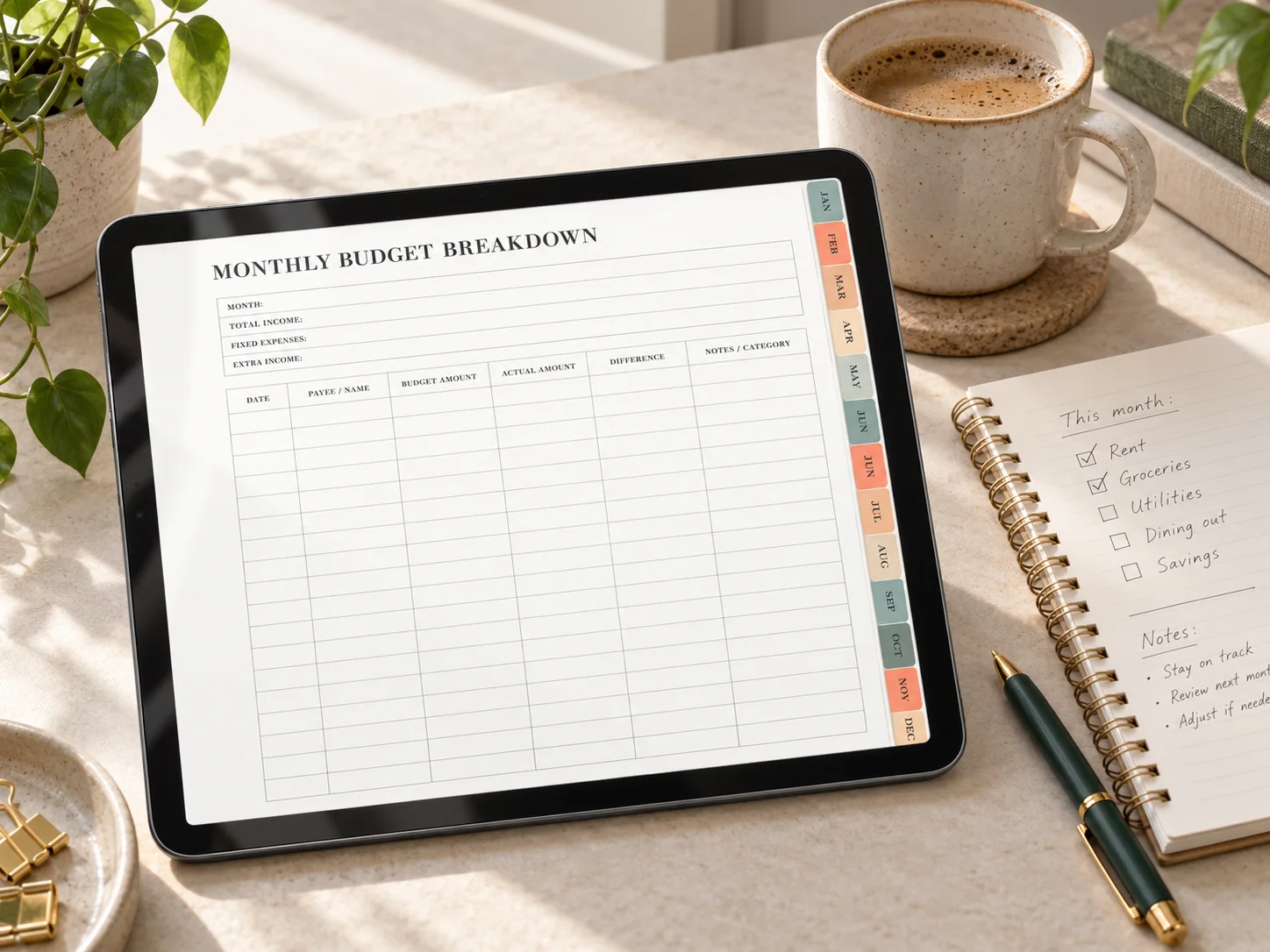
If you prefer handwriting on a tablet, the Digital Budget Planner, Financial Planner may suit this routine. Its public listing says it includes monthly and biweekly budget pages, daily spending logs, bill, debt, savings, and sinking-fund trackers, a weekly expense check-in and reflection, a monthly budget breakdown, and a yearly overview. It is described for use with GoodNotes, Noteshelf, or Notability.
For this article’s workflow, the most relevant sections are the monthly budget, spending records, reflection, and monthly breakdown pages. You do not need to use every section. The listing describes more than 200 pages and many additional trackers, so a simpler approach is to select only the pages that support your review.
 Month-end review
Digital Budget Planner, Financial Planner
A broad hyperlinked planner with monthly budget, spending, bill, debt, savings, reflection, and breakdown pages. It may suit someone who wants to complete the full month-end routine by handwriting on a tablet.
See the planner and included pages →A reusable end-of-month checklist
- Confirm actual take-home income.
- Check bills, renewals, and due dates.
- Compare planned and actual spending.
- Review savings and debt transfers.
- Identify the largest useful difference.
- Decide whether it was one-time, an estimate issue, or a system issue.
- Note what will already be different next month.
- Choose one specific adjustment.
- Put that adjustment into the next budget.
The goal is not to produce a flawless month. It is to make the next plan more accurate than the last one.
Frequently asked questions
When should I do a monthly budget review?
Choose a consistent time near the end of the month or in the first few days of the next month, after most transactions have posted. A last-Sunday review works for some people; others prefer the first payday of the new month. Consistency matters more than the exact date.
What if I did not track every expense?
Use bank and card statements for the transactions you can verify. Mark unknown cash spending rather than inventing a number. Then choose a simple way to record cash for the next month.
How many budget changes should I make?
Start with one primary change. Add a second only when it is urgent, such as a new bill or a confirmed income change. A smaller number of changes is easier to follow and evaluate.
Is being under budget in every category the goal?
No. A useful budget directs available money toward needs and priorities. Some categories will vary. The important questions are whether total spending fits available income, essential bills are covered, and your plan reflects what matters to you.
How is a monthly review different from a weekly money check-in?
A weekly check-in looks ahead to the next several days and helps prevent immediate surprises. A monthly review looks backward across the completed month, tests the assumptions in your budget, and changes the next month’s plan.
What if my income changes every month?
Compare the month’s actual income with the amount you planned, then note why it changed. For the next month, use a conservative baseline and plan the timing of income and expenses. A cash-flow view can be more useful than relying only on monthly totals.
The one-fix rule
“Next month, I will change __________ because this month showed me __________.”
That sentence connects the new decision to real evidence. It also gives you something clear to review next month. Over time, a series of small, evidence-based adjustments can make the budget more realistic without turning it into a constant exercise in restriction.
Sources
- Consumer.gov: Making a Budget
- Consumer Financial Protection Bureau: Your Money, Your Goals toolkit
- Consumer Financial Protection Bureau: Track your spending with this easy tool
- Consumer Financial Protection Bureau: Assess your spending
Written by Calm Budgets