A useful money vision board picture has four parts: a clear meaning, a realistic number or measure, a date, and one next action you control.
A money vision board can look beautiful and still be impossible to use. A beach photograph, a dream kitchen, a paid-off credit card, and a stack of cash may all feel motivating, but the board stays vague if you cannot explain what each picture asks you to do.
The solution is not to remove every inspiring image. It is to give each one a job.
For every picture you add, write a short meaning underneath it:
- What does this represent?
- What amount is connected to it?
- When would you like to reach it?
- What is the next action you control?
A picture of a quiet home might mean a six-month emergency fund. A passport could mean a $2,400 travel fund by next June. A free afternoon might represent reducing overtime after a debt is repaid. The image stays emotional, but the caption turns it into a financial decision.
Useful money vision board pictures show a specific goal, a financial habit, or the life a money decision is meant to support. Pair every image with a clear meaning, a realistic number or measure, a date, and one next action. If you cannot name any of those, the picture may be decoration rather than part of the plan.
Begin with the life, not a pile of money
Money is usually a means, not the final picture. People rarely want a bank balance simply to look at it. They want the security, time, choice, home, education, travel, generosity, or breathing room that the balance makes possible.
That is why a board covered only with cash, luxury cars, and account screenshots can feel strangely disconnected. It shows symbols of money without showing the life you are trying to fund.
Start with two questions:
- What would become easier if my money felt calmer?
- What would I choose if one financial pressure were removed?
Your answers create stronger image categories than a generic search for “wealth aesthetic.”
The four-part caption that makes a picture useful
Before looking at the nine categories, create a small caption card for every image.
Meaning
Name the outcome in ordinary language. “Freedom” is broad. “Three months of essential expenses available if work slows down” is clear.
Number
Use a dollar amount when the goal has a direct cost. For a habit or lifestyle image, use another measurable signal: four no-spend evenings per month, one weekly money check-in, or two freelance-free Saturdays.
Date
A date is a planning boundary, not a promise. Choose a month or quarter that lets you calculate a reasonable pace. You can revise it when circumstances change.
Next action
Write one action small enough to take this week: check the current balance, request a due-date change, cancel one unused subscription, transfer $25, or compare three travel estimates.
The Consumer Financial Protection Bureau’s money-goal worksheet uses the same practical bridge: identify the goal, calculate what is available to save, divide the goal by the number of months, and find the monthly amount needed. Your caption does not need to contain the whole calculation, but it should point toward it.
1. A safety picture for your emergency fund
Choose an image that represents steadiness rather than disaster. It might be a calm home, a repaired car, a full pantry, or a quiet night of sleep.
Caption example:
- Meaning: one month of essential expenses available;
- Number: $3,200;
- Date: March 31;
- Next action: total the current emergency balance tonight.
Avoid using a random large number because someone else called it the “right” emergency fund. Your first milestone can be smaller: one insurance deductible, one month of rent, or a starter buffer. The picture should represent the problem your own reserve is meant to solve.
2. A debt-free picture tied to one balance
A cut-up credit card or a bold zero can work, but a more personal picture may be stronger: the monthly activity you will afford when a payment disappears, the desk where you will open a zero-balance statement, or an uncluttered calendar representing fewer due dates.
Caption example:
- Meaning: pay off the store card;
- Number: current balance of $1,480;
- Date: February 28;
- Next action: confirm the balance and minimum payment.
Keep one debt per caption. “Debt free” may be the long-term destination, but the board becomes actionable when the current target is unmistakable.
3. A home image with the real first milestone
A dream house can hide several different goals: a down payment, moving costs, an emergency repair reserve, furniture, or simply a less expensive rental.
Decide which one the picture means now.
Caption example:
- Meaning: moving fund for deposit and first-month costs;
- Number: $4,500;
- Date: September 1;
- Next action: price the three costs separately.
If the home image represents a future that is still several years away, give it a nearer milestone. “Open a dedicated savings account” or “save the first $1,000” is easier to act on than a house price you cannot yet estimate.
4. A travel picture with the whole trip attached
Travel images are easy to collect because they are already attractive. They also encourage under-budgeting when the board shows only the destination.
Add a small cluster: destination, transportation, accommodation, daily spending, and one activity you care about. Then connect the cluster to one total.
Caption example:
- Meaning: seven-day trip without putting routine expenses on a credit card;
- Number: $2,400 total trip fund;
- Date: June 15;
- Next action: estimate transport and accommodation this weekend.
The point is not to predict every meal perfectly. It is to make sure the beautiful destination image represents the full financial goal rather than the flight alone.
5. A time-freedom picture with a money condition
Time goals are often the most meaningful and the hardest to caption. A slow morning, a parent picking up a child, or a free Friday may represent fewer work hours, a sabbatical, retirement, or enough savings to leave an unhealthy job.
Write the financial condition that would make the time possible.
Caption example:
- Meaning: reduce one freelance shift each month;
- Number: replace $300 of monthly income;
- Date: after the emergency fund reaches $4,000;
- Next action: calculate the average income from that shift.
This prevents the board from treating free time as something you should somehow “manifest” without acknowledging the tradeoff.
6. A career or business picture connected to an investment
A laptop, studio, storefront, qualification, or client calendar can represent earning more, changing careers, or building a business. Do not let one picture silently stand for all three.
Caption example:
- Meaning: complete the bookkeeping certification;
- Number: $750 tuition plus $100 materials;
- Date: enroll by January 15;
- Next action: compare the course schedule with the household budget.
If the goal is income growth, avoid placing an unsupported income figure on the board as though the result were guaranteed. Focus on the investment and actions you control: training, portfolio work, applications, outreach, or a defined offer.
7. A purchase picture with the total ownership cost
A car, phone, computer, or appliance should represent more than the sticker price. Add tax, accessories, delivery, setup, insurance, maintenance, or the cost of replacing something else.
Caption example:
- Meaning: replace the unreliable laptop without financing it;
- Number: $1,350 including backup drive and setup;
- Date: April 30;
- Next action: set a maximum price before comparing models.
This turns the board into a boundary as well as an aspiration. The picture tells you what you want; the number helps protect you from buying a more expensive version in the moment.
8. A generosity picture with a repeatable rule
If generosity matters to you, include it deliberately. The image might represent monthly giving, helping family, hosting friends, volunteering, or donating to one cause.
Caption example:
- Meaning: give consistently without borrowing from bill money;
- Number: $25 per month;
- Date: begin next payday;
- Next action: add a giving category to the next budget.
A repeatable amount is often more useful than a vague image of abundance. It makes generosity part of the plan rather than something left to whatever happens to remain.
9. A money-routine picture that shows the behavior
Not every image needs to be a future purchase. Include at least one picture of the routine that will support the other goals: a weekly review, meal planning, checking subscriptions, transferring savings, or preparing a payday plan.
Caption example:
- Meaning: know what the money needs to do before spending it;
- Measure: 15-minute review every Sunday;
- Date: next Sunday at 6:00 PM;
- Next action: put the first review on the calendar.
This is where an if-then plan can help. Research on implementation intentions describes plans that connect a situation with a response: “If it is Sunday at 6:00 PM, then I will open the budget and choose next week’s transfer.” The picture becomes a cue for a specific behavior rather than a reminder to “be better with money.”
Pictures that usually need a clearer caption
Some images are not wrong, but they are too broad on their own.
- A stack of cash: How much, for what purpose, and where will it be kept?
- A luxury car: Is the goal ownership, a test drive, a reliable used car, or a transportation budget?
- A credit score screenshot: Which behavior or borrowing decision is connected to it?
- A generic “financial freedom” quote: What would change first in your real week?
- An expensive home: Is the next milestone a deposit, down payment, repair fund, or lower housing cost?
- A passive-income graphic: What asset or work creates the income, and what action comes next?
If you love the image, keep it. Just do not count it as a working financial goal until you can explain its meaning.
How many money vision board pictures should you use?
Start with six to nine. That is enough to cover different parts of your financial life without turning the board into a crowded feed of competing wishes.
A balanced first board might include:
- one safety goal;
- one debt or obligation goal;
- one future purchase or experience;
- one career or income-building action;
- one time or lifestyle goal;
- one weekly money routine.
You can add other images later. A smaller board makes it easier to notice when two pictures represent the same goal or when one image has no next action.
A practical Vision Board Planner example
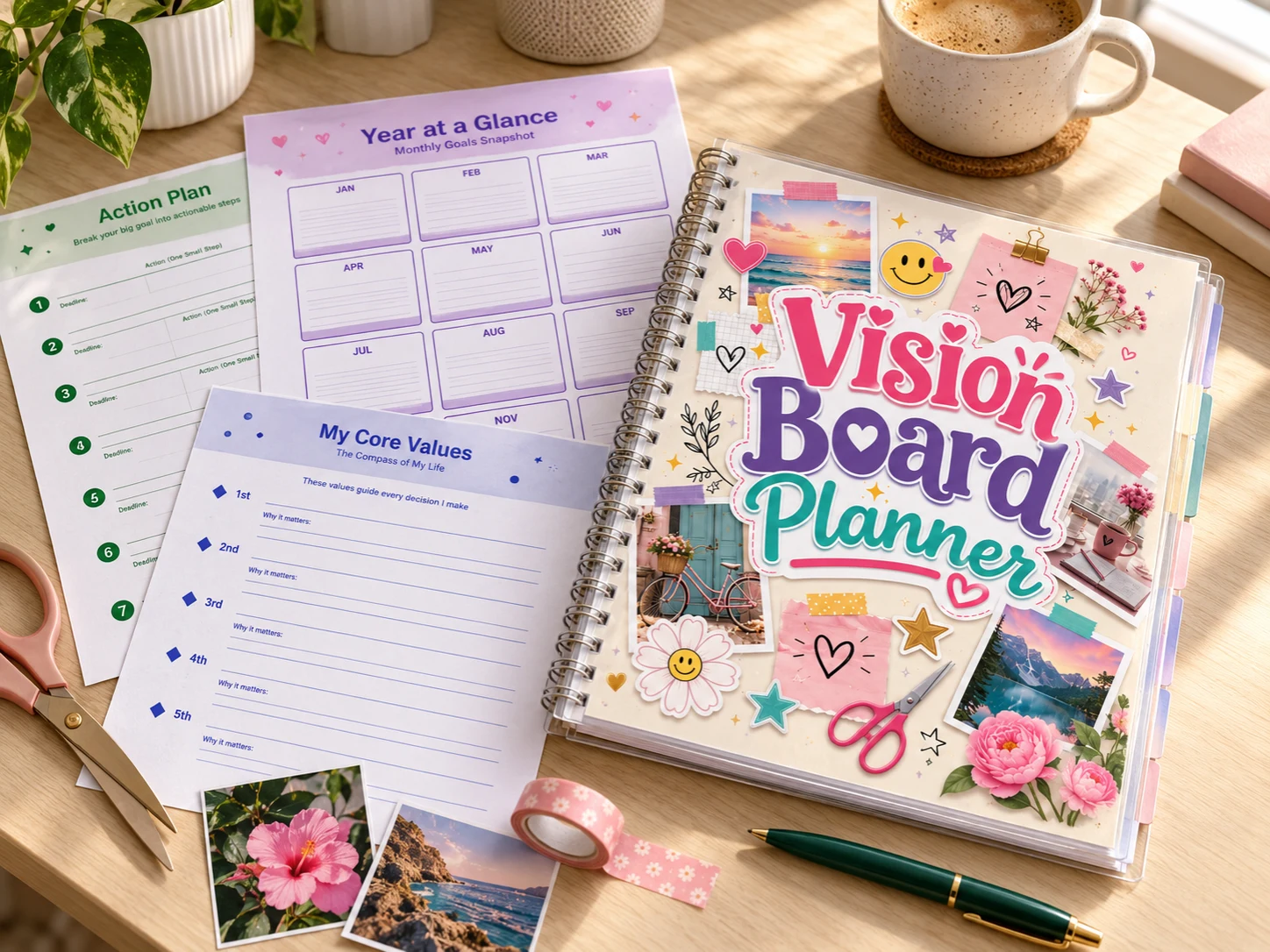
The approved Vision Board Planner is one example of a system that places the collage next to planning pages instead of leaving it as a standalone mood board. Its public listing describes 120 printable PDF pages and 120 editable Canva pages. It includes multiple formatted vision-board spaces, a Financial Freedom section, SMART-goal breakdowns, action plans with deadlines, milestone trackers, obstacles-and-solutions planning, habit logs, and review pages.
For a money-focused use, you would not need to complete every life category. Begin with the Financial Freedom pages, one vision-board spread, and the action-plan page. Use the board for the emotional picture, the financial page for the amount, and the action plan for the first controllable step.
 Vision to plan
Vision Board Planner
A printable and editable planning system that pairs vision-board spaces with financial goals, SMART-goal breakdowns, action plans, deadlines, and milestone tracking.
See the planner and included pages →Build your board in four passes
Pass 1: collect without judging
Gather images that feel relevant. Use your own photographs, magazines, screenshots you are allowed to use privately, or licensed images. Do not worry about arranging them yet.
Pass 2: sort by meaning
Group the images into safety, debt, home, travel, time, career, purchases, generosity, and routines. Remove duplicates that represent the same outcome.
Pass 3: write the captions
Add meaning, number, date, and next action. If you cannot write a useful caption, place the image in a “maybe later” folder rather than forcing it onto the board.
Pass 4: choose one active picture
Circle or highlight the image you will work on first. The rest of the board can remain visible, but one active goal keeps this week’s decision clear.
When you are ready to move from selecting pictures to scheduling progress, use the Calm Budgets guide to turn one money vision board image into a 12-week plan.
Frequently asked questions
Does a money vision board have to be physical?
No. A corkboard, paper collage, Canva page, tablet wallpaper, or private digital document can all work. Choose the format you will actually revisit and can update without friction.
Should I include exact account balances?
Only if the board is private and you are comfortable displaying them. A milestone such as “first $1,000” or a percentage can preserve privacy while keeping the goal measurable.
Can I include goals that are not about spending?
Yes. Time, stability, flexibility, generosity, reduced stress, and better routines are legitimate money goals. Write the financial condition or behavior connected to the image.
What if I do not know the exact cost yet?
Use a research action as the first caption: “Get three estimates by October 20.” Replace it with a working range once you have better information.
How often should I update the board?
Review it briefly each week and more carefully once a month or quarter. Change an image when the goal changes, the estimate becomes outdated, or the picture no longer reflects what you want.
Will a vision board make the goal happen?
No image guarantees a financial result. The board can clarify what matters and keep it visible. Progress still depends on income, expenses, available resources, decisions, and actions over time.
Choose one picture and finish its caption
Do not rebuild your entire financial life tonight. Choose one image that matters, then write its meaning, number, date, and next action.
That small caption changes the question from “What do I wish my life looked like?” to “What does this picture ask me to do next?”
Sources
- Consumer Financial Protection Bureau: My New Money Goal worksheet
- Consumer.gov: Making a Budget
- Gollwitzer and Sheeran: Implementation intentions and goal achievement
Written by Calm Budgets