The booked costs are the easy part. Daily spending is where travel budgets actually go over.
Most travel budgets only include the big three: flights, accommodation, and maybe a rental car. The trip then gets more expensive one coffee, one museum ticket, and one airport taxi at a time — and the real total only becomes clear on the card statement afterwards.
A travel budget that holds up plans the whole trip before you book, and tracks it while you are away.
List every category, not just the big ones
- Getting there: flights or trains, baggage fees, transfers to and from the airport.
- Staying there: accommodation, including taxes and cleaning fees.
- Getting around: local transport, taxis, fuel, parking.
- Food: a daily amount for meals and coffee.
- Activities: tickets, tours, entry fees.
- Before you leave: travel insurance, luggage, pet care, visas.
- Buffer: 10% for the things nobody plans for.
The booked costs are the easy part. Daily spending — food, transport, small tickets — is where travel budgets actually go over.
Set a daily spending number
Estimate food, local transport, and small costs per day, then multiply by the number of days. A daily number is easy to follow while traveling: if dinner costs more today, lunch tomorrow can be simpler.
Search for typical prices in your destination before you go — a coffee or a metro ticket can cost very different amounts in different cities.
Save for the trip in advance
Divide the total by the months until departure. A $1,800 trip in six months is $300 a month set aside in a separate place. Booking deposits then come out of trip savings rather than your regular monthly budget.
Track spending during the trip
Take one minute each evening to log what you spent that day. It is much easier than reconstructing a week of foreign-currency card charges afterwards, and it shows early whether the daily number is realistic.
A simple trip-budget routine
- Before booking: estimate every category and the total.
- Before leaving: confirm booked costs and set the daily number.
- Each evening: log the day's spending.
- After returning: compare planned vs. actual to budget the next trip more accurately.
A realistic example
Imagine a five-day city trip: train $180, accommodation $520, daily spending of $70 ($350 total), activities $120, insurance $35, and a 10% buffer of about $120 — roughly $1,325 in total. On day three, dinner runs $25 over; the next day's lunch is a picnic, and the trip finishes under the daily number. This is an illustrative example, not a reported personal result.
What usually breaks a travel budget
- Budgeting only flights and hotel. Daily costs often match them.
- No buffer. Something unexpected almost always happens.
- Not tracking during the trip. Overspending is only visible once it is too late to adjust.
- Forgetting pre-trip costs. Insurance, luggage, and pet care add up.
A travel planner with budget and expenses included
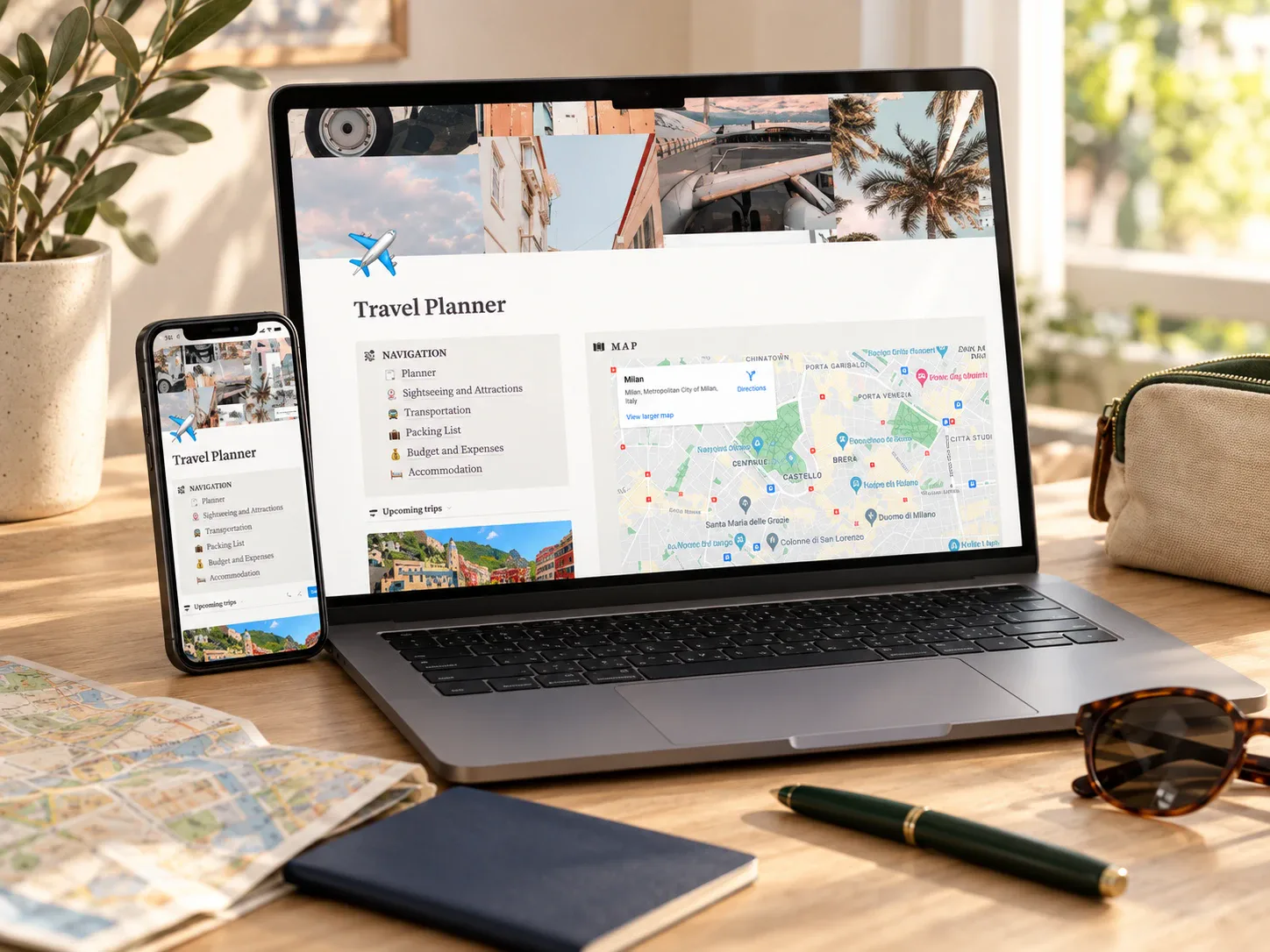
If you would like itinerary, packing, and budget in one place, one Notion template has held up well with other buyers:
 Trip planning
Notion Travel Planner Dashboard
Budget and expenses, itinerary, transport, accommodation, and a packing list in one Notion dashboard — built for planning a trip and tracking it on the go.
Read the planner guide →Questions people ask before starting
How much buffer is enough?
Around 10% of the total works for most short trips. Longer or more remote trips benefit from a larger buffer.
Should I use cash or cards abroad?
That depends on your destination and card fees. Whichever you use, log daily spending the same way.
How do I budget for a trip with friends?
Agree on shared costs before booking and keep a simple shared list of who paid for what.
Start with the trip you are dreaming about
Pick one trip and estimate each category on the list above. Add the 10% buffer. That total — and the monthly amount to save for it — turns a wish into a plan.
Written by Calm Budgets