Start with broad categories that help you make decisions. Split a category only when the extra detail changes what you do.
Opening a blank budget can feel surprisingly difficult. You know you need categories, but how many? Should coffee have its own line? Do groceries and household supplies belong together? Where should annual insurance, gifts, or a vet bill go?
The easiest answer is not to find the perfect list. It is to start with a short list that helps you make decisions. Your first realistic budget does not need 30 categories. It needs enough structure to show what must be paid, what you want to protect, and where you still have a choice.
Start broad. Split a category only when the extra detail would change a decision, reveal a due date, or protect a goal.
The quick list: 12 budget categories to start with
You may not need all 12. A person without a car can remove car-related costs. Someone with children or pets may want a dedicated category for them. A freelancer may need separate business and tax categories. Treat this as a starting point, not a rulebook.
What belongs in each category
Housing
Use this category for the cost of keeping a roof over your head: rent or mortgage, property fees, and any regular housing payment that does not fit naturally elsewhere. Keep housing as one line in your first budget. Split it later only if a separate number would help you plan.
Utilities and communication
This category can include electricity, gas, water, trash, internet, and phone service. Some people prefer separate utility lines because the amounts change at different times of year. Others find one total easier to maintain. Either approach works if you can still see what is due and when.
Groceries and household basics
Use this for food bought for home, cleaning supplies, paper products, and small household items purchased during a normal grocery trip. Combining these costs makes a first budget easier to maintain. If household supplies keep distorting your grocery number, split them after one month.
Transportation
This may include fuel, public transportation, parking, rideshares, and routine maintenance. Car payments and insurance can stay here or move into their own fixed-expense lines. Choose the setup that shows both the next required payment and the flexible part of transportation spending.
Health and insurance
Use this category for regular health costs such as prescriptions, co-pays, therapy, dental care, and health insurance if it comes out of your take-home income. If several insurance bills have different due dates, tracking each one separately may be clearer.
Minimum debt payments
Include the minimum required payments on credit cards, loans, or other debts. Keep extra debt payments separate from the minimum. The minimum is an obligation; the extra payment is a goal you can adjust without accidentally missing the bill.
Savings and emergency fund
Savings belongs in the budget, not in the amount left over by accident. Start with one combined savings line if several goals feel overwhelming. Split it when the goals need different deadlines or contribution amounts.
Sinking funds and irregular expenses
A sinking fund is money set aside gradually for a cost you know is coming, even if it does not arrive every month. Annual insurance, car repairs, school costs, holiday gifts, travel, home maintenance, and professional renewals can all fit here. The full method is explained in the sinking-funds guide.
Dining out
Keeping restaurants, takeaway, delivery, and coffee separate from groceries is useful because the two categories answer different questions: what does it cost to feed the household, and how much convenience or social spending feels comfortable this month?
Personal care and clothing
This can cover haircuts, toiletries not included with household basics, clothing, and shoes. If clothing is occasional rather than monthly, you may prefer to treat it as a sinking fund.
Fun, hobbies, and subscriptions
This is not a category you have to eliminate. A realistic budget makes room for enjoyment at a level your current income can support. If subscriptions are difficult to notice, separate them so renewal dates do not disappear inside a larger fun total.
Family, pets, gifts, or giving
Use this final flexible category for the responsibility that is genuinely part of your life: child expenses, pet care, family support, charitable giving, or gifts. If two of these areas are both significant, give each one its own category instead of forcing unrelated costs together.
Organize the list into four simple groups
| Group | Examples | The question it answers |
|---|---|---|
| Fixed needs | Housing, regular utilities, insurance, minimum debt payments | What must be paid? |
| Flexible needs | Groceries, transportation, health costs | What is necessary but adjustable? |
| Future money | Emergency savings, sinking funds, extra debt payments | What am I preparing for? |
| Optional spending | Dining out, personal spending, hobbies, subscriptions, gifts | Where do I still have a choice? |
The four-group view explains the purpose of the money without creating dozens of tiny lines. The categories underneath still show where a useful change may be possible.
When a category deserves its own line
Create a separate category when at least one of these is true:
- You make a different decision about this spending than the rest of the group.
- The amount is large enough to affect the month.
- The bill has its own due date or renewal date.
- The cost is irregular and needs money set aside in advance.
- The category represents a goal you want to protect.
Merge categories when they are small, behave in the same way, and do not help you make a different decision. You probably do not need separate lines for shampoo, paper towels, dish soap, and laundry detergent. Household basics may be enough. Groceries and dining out, however, are often worth separating because one is a household need and the other is usually more flexible.
A realistic first-month example
| Transaction | Category | Why |
|---|---|---|
| Rent | Housing | A fixed monthly obligation |
| Electricity and internet | Utilities and communication | Regular services with due dates |
| Food and cleaning supplies from one supermarket trip | Groceries and household basics | One broad line is enough to start |
| Automatic emergency-fund transfer | Savings and emergency fund | A goal planned before leftover spending |
| Money for annual car registration | Sinking funds | A predictable future expense |
| One takeaway meal | Dining out | Separate from the cost of food at home |
Every meaningful expense has a home, but the system stays simple enough to update. That matters more than building a perfect taxonomy.
Set up your budget categories in 15 minutes
- Write down fixed bills. List housing, utilities, insurance, minimum debt payments, and other regular obligations.
- Review the last 30 days. Group flexible purchases into broad patterns such as groceries, transportation, dining out, and personal spending. Look for patterns, not reasons to judge yourself.
- Add future money. Choose at least one savings contribution and one irregular expense that needs a sinking fund.
- Add realistic optional spending. Include the spending you are likely to make. A plan that pretends you will never eat out, buy a gift, or enjoy a hobby is easy to abandon.
- Leave one temporary buffer. A small Other category can catch something you genuinely forgot. Review it at month-end instead of letting it become a permanent hiding place.
If you are building a budget for the first time, pair this list with the simple beginner budgeting system.
When to merge or split categories
Use your first budget for four weeks before redesigning it. At the end of the month, ask:
- Which category was too broad to guide a decision?
- Which category was so small that tracking it separately added no value?
- Which irregular cost surprised me even though I could have predicted it?
- Which goal did I want to fund but forget to include?
Split a category when more detail would change what you do. Merge categories when the extra detail only creates work. For example, split transportation into fuel and car maintenance if you want to control weekly fuel spending while building a repair fund. Merge books and movies into fun if separate limits do not affect your choices.
Common beginner category mistakes
- Copying someone else's list exactly. A template should save setup time, not decide your priorities.
- Creating too many categories too soon. Extra detail makes every purchase harder to enter. Add it only when it answers a real question.
- Hiding predictable costs in miscellaneous. Move annual fees, gifts, and repairs into sinking funds.
- Treating savings as whatever remains. Give savings a visible line and a planned transfer.
- Making the budget too strict to live with. A realistic budget includes flexible and enjoyable spending.
A simple digital option for customizable categories
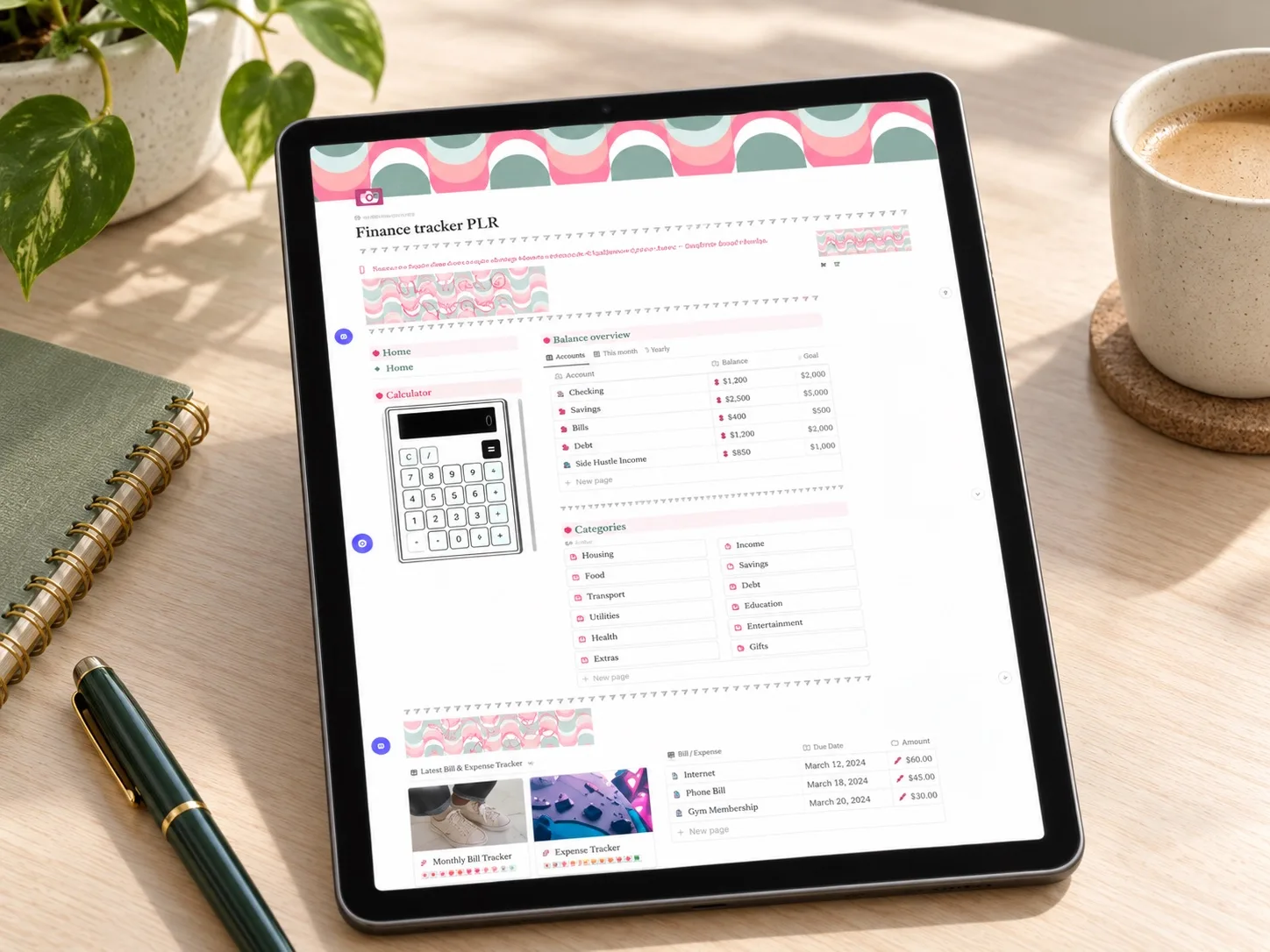
If you prefer a digital setup, a focused tracker can keep broad categories, savings goals, and weekly updates in one place without turning the budget into a large life-planning system.
 Customizable categories
PLR Finance Tracker
Income and expense tracking, editable categories, a savings tracker, a to-do list, and a wishlist in one focused dashboard. You can begin with the broad list above and remove anything you do not use.
Read the planner guide →Questions people ask about budget categories
How many budget categories should a beginner have?
There is no required number. Twelve broad categories are a manageable starting point, but your final list may be shorter or longer. Use the fewest categories that still help you plan bills, goals, and flexible spending.
Should groceries and household items be separate?
They can stay together at first, especially if you buy them in the same stores. Split them only if household purchases repeatedly make the grocery total difficult to understand.
Is savings an expense category?
For planning purposes, savings should have its own category. It is not money consumed by a purchase, but giving it a line makes the contribution intentional.
Where do annual expenses go in a monthly budget?
Put them in a sinking-fund or irregular-expense category. Estimate the future cost, divide it by the months before it is due, and include that contribution in the monthly plan.
What should go in miscellaneous?
Use miscellaneous only as a temporary first-month buffer. Repeated expenses deserve a named category; one-time small expenses can remain in the buffer.
Start with a useful list, not a perfect one
Choose the categories that match your life, enter the costs you already know, and use the list for one month. Your categories are working if they help you answer three questions: what must be paid, what am I preparing for, and where do I still have a choice?
You can refine the list later. The best first budget is not the most detailed one. It is the one you can understand, update, and use for your next decision.
Written by Calm Budgets